
• Skip to main content
  • Skip to secondary menu
  • Skip to primary sidebar
  • Skip to secondary sidebar
  • Skip to footer

  • Opinion
  • Health IT
    • Behavioral Health
    • Care Coordination
    • EMR/EHR
    • Interoperability
    • Patient Engagement
    • Population Health Management
    • Revenue Cycle Management
    • Social Determinants of Health
  • Digital Health
    • AI
    • Blockchain
    • Precision Medicine
    • Telehealth
    • Wearables
  • Life Sciences
  • Investments
  • M&A
  • Value-based Care
    • Accountable Care (ACOs)
    • Medicare Advantage

6 Key Analytics for Successful Population Health Management Infographic

by Fred Pennic 01/30/2013 23 Comments

  • LinkedIn
  • Twitter
  • Facebook
  • Email
  • Print

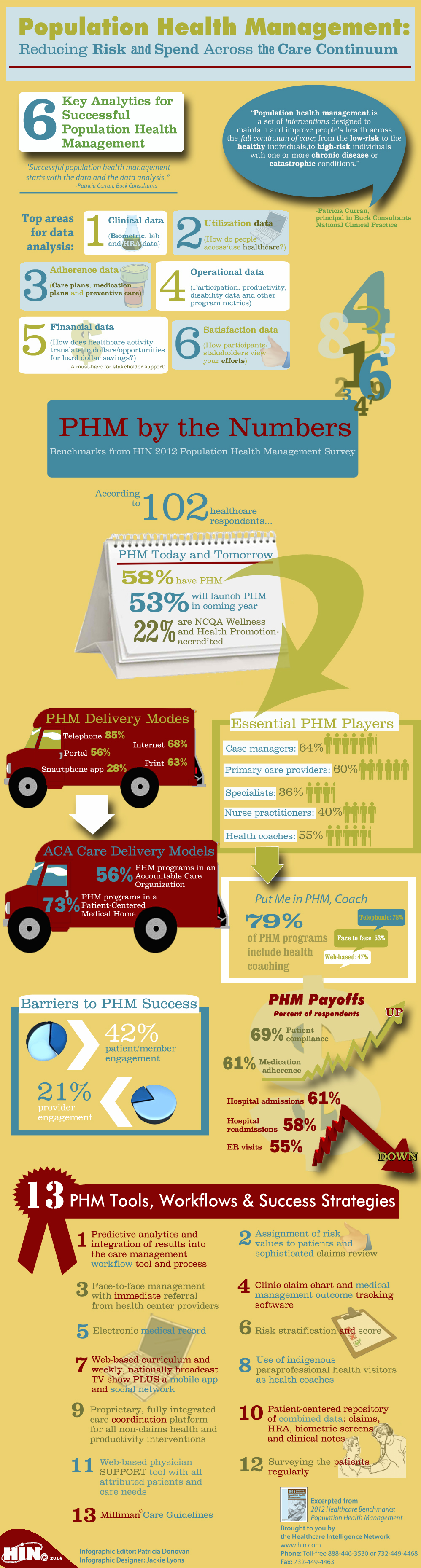
6 key analytics for successful population health management infographic created by HIN outlines key analytics, barriers, tools and workflows to ensure successful PHM.

We spend almost twice as much, per-person, as any other nation closing in on 17.9 percent of our gross national product, yet it is hard to prove if we are any healthier. To control these rising healthcare costs with a big picture delivery approach that anticipates the needs and improve outcomes, healthcare organizations and employers are turning to population health management (PHM), defined as the management of integration and outcomes measurements of any program affecting the health and productivity of a specific population or group. Healthcare’s value-based purchasing increasingly favors a population-centric approach to health management, identifying risk across the care continuum.

[See also: 6 Pillars of Responsible Population Health Management]

Surveying patients regularly about their experience and using electronic medical records are just a few PHM strategies. This new infographic visualization created by Healthcare Intelligence Network outlines key analytics, barriers, tools and workflows to ensure successful management of specific populations, drawing from results of their 2012 Population Health Management survey.

Successful PHM starts with data management and analytics. The infographic highlights the following 6 key analytics for successful population health management:

  1. Clinical Data
  2. Utilization Data
  3. Adherence Data
  4. Operational Data
  5. Financial Data
  6. Satisfaction Data

Other key data points presented in this infographic  shown below are:

  • Top areas for data analysis, including clinical, utilization and adherence data
  • Use of PHM delivery models: telephone, Internet, portal, print or smartphone app;
  • PHM payoffs, such as increases in medication adherence and decreases in hospital readmissions;
  • Ideas for successful PHM, including face-to-face management with immediate referral from health center providers.

CLICK IMAGE TO ENLARGE
 

6 Key Analytics for Successful Population Health Management
Source: Healthcare Intelligence Network

featured image credit: http://info.healthdirections.com

  • LinkedIn
  • Twitter
  • Facebook
  • Email
  • Print

Tap Native

Get in-depth healthcare technology analysis and commentary delivered straight to your email weekly

Reader Interactions

Primary Sidebar

Subscribe to HIT Consultant

Latest insightful articles delivered straight to your inbox weekly.

Submit a Tip or Pitch

2026 Predictions & Trends

Healthcare 2026 Forecast: Executives on AI Survival, Financial Reckoning, and the End of Point Solutions

2026 Healthcare Executive Predictions: Why the AI “Pilot Era” Is Officially Over

Most-Read

HHS Launches 'OneHHS' AI Strategy to Integrate AI Across CDC, CMS, and FDA for Efficiency and Public Trust

HHS Launches ‘OneHHS’ AI Strategy to Integrate AI Across CDC, CMS, and FDA for Efficiency and Public Trust

Kristen Hartsell, VP of Clinical Services, RedSail Technologies

The Pharmacy Closures Crisis: How Independent Pharmacies Are Fixing Pharmacy Deserts

From Overwhelmed to Optimized: How AI Agents Address Staffing Challenges and Burnout in Healthcare

From Overwhelmed to Optimized: How AI Agents Address Staffing Challenges and Burnout in Healthcare

The VBC Paradox: Why Hospitals Are Doubling Down on Value-Based Care While Revenue at Risk Lags

The VBC Paradox: Why Hospitals Are Doubling Down on Value-Based Care While Revenue at Risk Lags

Tebra Secures $250M to Challenge Legacy EHRs with AI-Powered Automation

Tebra Secures $250M to Challenge Legacy EHRs with AI-Powered Automation

AstraZeneca Selects Salesforce Agentforce Life Sciences to Deploy AI-Powered Global Customer Engagement

AstraZeneca Selects Salesforce Agentforce Life Sciences to Deploy AI-Powered Global Customer Engagement

Aidoc Partners with NVIDIA MONAI to Scale Open-Source Clinical AI

Aidoc Partners with NVIDIA MONAI to Scale Open-Source Clinical AI

RapidAI Secures FDA Clearance for Five New Deep Clinical AI Modules, Expanding Enterprise Imaging Platform

RapidAI and AWS Deepen Partnership to Scale Clinical AI in Healthcare

Greece and Sword Health to Build AI-Powered Healthcare Front Door

Greece and Sword Health to Build AI-Powered Healthcare Front Door

GE HealthCare Acquires Intelerad for $2.3B to Create Cloud-First, AI-Enabled Imaging Ecosystem

GE HealthCare Acquires Intelerad for $2.3B to Create Cloud-First, AI-Enabled Imaging Ecosystem

Secondary Sidebar

Footer

Company

  • About Us
  • Advertise with Us
  • Reprints and Permissions
  • Op-Ed Submission Guidelines
  • Contact
  • Subscribe

Editorial Coverage

  • Opinion
  • Health IT
    • Care Coordination
    • EMR/EHR
    • Interoperability
    • Population Health Management
    • Revenue Cycle Management
  • Digital Health
    • Artificial Intelligence
    • Blockchain Tech
    • Precision Medicine
    • Telehealth
    • Wearables
  • Startups
  • Value-Based Care
    • Accountable Care
    • Medicare Advantage

Connect

Subscribe to HIT Consultant Media

Latest insightful articles delivered straight to your inbox weekly

Copyright © 2025. HIT Consultant Media. All Rights Reserved. Privacy Policy |