

Lois Drapin shares her insights on Validic’s data integration and innovation offerings along with the wisdom its founders have for fellow entrepreneurs.
One of the keystone aspects of “ecosystems” is interoperability and this also applies to the data pipeline that flows from health apps and devices to the appropriate segment of the healthcare delivery system, and eventually, to the users—patients, consumers and/or medical professionals such as physicians and nurses or other clinicians. By now, we all know that the capture and analytics for both “big” and “small” health data are business imperatives for healthcare in the US. With data of this nature, we can embrace our understanding of behavioral change at the individual and population levels. The anticipated outcomes of behavioral change may power operational and cost efficiencies in the healthcare industry.
But data will no longer come from just inside the healthcare delivery system. In addition to the changing technology enablement within the health system, as we all know, data will flow from many things—in fact, The Internet of Things (IoT). This means that data that relates to our lifestyle, wellness and health will pour from the many types of wearable devices not now connected to the heath delivery system. In addition to our computers, tablets, phablets and smartphones, are the many sensors paired with tech innovations such as the wearables— from wristbands, smartwatches, clothing (from shoes to headbands), glasses, contacts, and pendants — to things such as refrigerators, clocks, mattresses, scales, coffee pots, cars, and even, toilets…all of which are predicted to become an important market in the coming years.
Validic, based in Durham, NC, has put itself smack in the middle of that market by providing easy, affordable, efficient and accessible data integration services to four customer markets, or what CEO Ryan Beckland and Cofounder and CTO Drew Schiller refer to as the 4Ps: payers, providers, preventive-wellness companies and pharma. Validic also works with consumer electronics companies and infrastructure companies. The data they pipe to these customer segments currently comes from device and health app developers. You can imagines as the IT market grows, data pertaining to health-related initiatives might also participate with Validic.
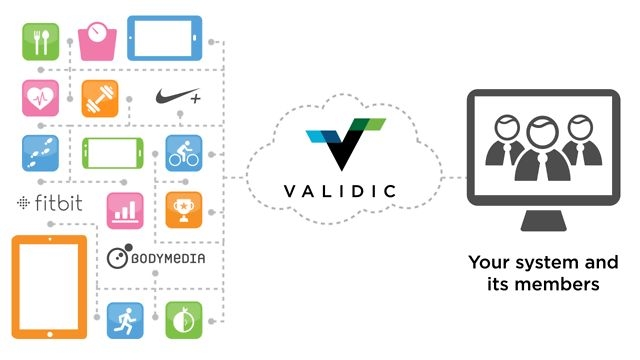
Beckland and Schiller admit their website requires a bit of updating, but they have integrated 123 devices and apps. I would bet that this number has increased since the first of the year, when I last spoke with them. They do this by providing the Validic Enterprise mHealth API to developers and customers. They like to say that Validic provides a “one-to-many connection for healthcare businesses and app developers.” Beckland and Schiller believe their enterprise API will become a true standard for interoperability. Think about this. This is a company without skin in the game, neither in the mHealth app or wearables markets, nor does it develop or own any proprietary device or app to protect. Validic sits in the middle of all that is happening with let’s say, neutrality, and provides customers and developers with an assist toward attainment of their business goals. The stream of data they can provide to customers will vary with the specific business-use case. Moreover, hospitals, ACOs, pharma, health plans and wellness companies won’t have to initiate negotiations with each and every device and app out there. Customers can have turnkey data access.
You may have heard about Validic from initial reports published in November 2013 on MobiHealthNews, announcing that Mark Cuban (one of TV’s Shark Tank entrepreneur-investors known for his ownership of Magnolia Pictures, Landmark Theaters, and the Dallas Mavericks) had just participated in Validic’s $760,000 seed round. It’s one of those announcements that makes you do a double take, and well, keep an eye on the ball, so to speak.
According to its founders, Validic collects 200 data points across all apps and devices— a wide range that includes fitness and activity tracking, nutrition and biometric data (weight, blood pressure, oximetry, glucometry, among others), data of interest to medication adherence in COPD, asthma, and other data of interest to their various customers. The data is de-identified, and Schiller affirms that Validic is “fully HIPPA-compliant.” Validic connects to devices and apps by providing its Enterprise API and by doing that, they are providing a large population data set available to all participants.
Validic soft launched in January 2013 and had its market launch in April. According to its founders, Validic will be deployed with a 30-million population base during Q1 2014. Under its current contracts, the company is looking at an additional 70 million lives in the Q2. With Validic’s recent attendance at mHIMSS and CES 2014, my bet is that Beckland and Schiller brought home some new contracts, customers and developers.
Continue reading

Validic is killer. Killer product. Killer team.
There’s certainly room for competition in their category, and I only expect more companies to mimic their model, but they’re already executing so well. Smart pick-up by Cuban. I’d say they’re already essential.
Anyone who can integrate with them has the capability to integrate directly with sensors also. So why pay them a markup when it is not needed. The value proposition is unclear and there are many players doing this since it is easy to do and obviously not very expensive to do.
.
Sam- The question for our customer is not whether they *can* integrate directly with the sensors. The questions is whether they *should* integrate directly with the sensors. In other words, every company has to make a choice for how they deploy limited, very expensive, technological resources. When you are trying to build a competitive advantage in the market, time is of the essence. Our customers feel that they can move much faster on other critical parts of their tech by building a single integration to Validic and refocusing their team on other important parts of their business. On face value, you have to admit that maintaining a single API connection to Validic will be both easier and cheaper for you than building and maintaining 123 one-off integrations.
To back up what @ryan_beckland:disqus said, we’re (Prime) a Validic customer and what he said is exactly why we use Validic. I’d just summarize it as “build or buy”. We buy Validic so we don’t have to spend time building and maintaining dozens of integrations. Keeps our dev resources open to do other things, saves us time and money in the long run.
Also there is basically no one doing this on the level Validic is.
I agree maintaining a single API is easier, but the decision depends on what one has to pay for it. An API integration takes between 1-3 man days or $1-3,000. If a company wishes to support say 10-20 sensors/devices, they will need $25-50,000 to do it, which would be a one time fee (non-recurring). On the other hand, the single API is a great option for startups like Prime building a business, since all they now distribute the cost per month (recurring). When they scale up, they can integrate directly and switch over.
Well, building a single API integration doesn’t typically take 1-3 days if you are serious about QA and testing. And you have to also consider that once you get into supporting several of these you start having to build other elements in order to normalize the data from disparate source (e.g., time zone conversions, units, time, distance, etc etc). Then once you have all of your integrations built, guess what. The API vendor pushes a change that breaks your integration. Or they change the way that a particular unit is reported (kilocalories vs. calories). The API vendor doesn’t tell you about these changes, of course, because they don’t have an SLA and therefore aren’t accountable to you. That happens *all the time* so you need to make maintenance and daily testing a part of someone’s regular job. The more APIs you add, the bigger of a problem you have here.
If all you need for your business is to build 2 or 3 device integrations, then I don’t think Validic is a good fit for you. You would be better served to just build those on your own. Our customers believe that the world of mHealth devices is getting bigger and more complex. There are more devices coming on the market every month, and those devices are getting more powerful. Our customers don’t want to have to try to pick which devices are going to be the winners and loser in the market. They want to focus their team on driving their business’s core value proposition, and not on building and maintaining commodity tech like API integrations.
Most competent development teams could build a word processing tool. But Word is so cheap and easy, why would they? Most development teams could build their own bug tracking tools. But there are so many, why would they? Most development teams could build their own server architecture. But AWS is so cheap, why would they? The companies we work with are trying to focus on core value, not on building API integrations.
As it states on the Validic website-” *Deploy in Hours*- Validic can be deployed in hours, not months or years. With one simple call to the Validic Enterprise mHealth API…” It seems API’s can be integrated in hours if not 1-3 days. We have seen it being done in less than 8 hours for many of the vendors esp if one has implemented OAuth and REST API’s once before.
I agree that there is value of a single API when one is trying to integrate many sensors- but most companies select a few to work with. A good example is there are over 75 glucometers on the market but most health plans only reimburse for 2-3 vendors. A recent article suggested Fitbit, Jawbone and Nike Fuel Band, have 97% of the activity monitor market.
Also, HealthVaullt provides such multi-sensor-to-one API. They also have integrated many sensors and are adding more everyday. They also have integrated data feeds form labs, EMR’s etc which makes the data that much richer. Given their size, one also does not have to worry about them running out of cash.
Just on that 97% number real quick, if you’re talking about http://mobihealthnews.com/28825/fitbit-jawbone-nike-had-97-percent-of-fitness-tracker-retail-sales-in-2013/ (or even any other that’s citing the NPD data) keep in mind NPD only tracks retail, not direct sales. Not saying the 97% is necessarily off but we don’t have the whole story here so it’s not wise to throw that number around as evidence of anything.
No developers build on HealthVault. Also HV is primarily about manual data entry. I’d also like to see how many people actually use HealthVault, considering they haven’t ever released user or engagement numbers. I’m guessing adoption is lower, engagement is lower, and linking to other data sources is essentially unused.
Sam- The reason that most companies only work with a few sensors is because they don’t want to spend the tech resources to build and maintain more integrations. We hear that over and over again from our customers, who are the largest health companies in the world. Our customers don’t want to try to handicap which devices are going to be successful in the market.
Also, you should be aware that the Fitbit, Jawbone, and Nike having 97% of the market is highly misleading. Really, they are only tracking sales at Best Buy, Amazon, and a couple other big retailers. The report leaves out companies like Omron and A&D entirely, who sell super high volume low cost devices via Walmart, Walgreens, and a host of other retailers. As with any statistic, you really have to dig into what is being measured here.
Certainly HealthVault is a great consumer-facing product. It is very different from Validic in the sense that Validic is a backend infrastructure technology with no end user facing components at all.
I think it all gets down to the business case. Validic isn’t going to be a fit for everyone, and that is fine with us. Our customer is looking for a way to manage a robust set of integrations easily so they can work on more important things.
I will be interested to see what validic’s accelerator looks like, we are looking at various options to get our mhealth behavior modification platform live, bluetooth and tidepool are free so they are obvious choices, qualcom’s platform is not in production so they are a definite risk for us. Validic is a new player but much of their data we don’t need since our platform has its own accelerometer/pedometer feature, so we may need special pricing, and since we are a startup with an as yet unknown enterprise business model we are especially cost conscious, and prefer free ( tidepool/bluetooth) We will be working with validic’s team to see if they have value to us, an accelerator environment might add value to us
Natalie Hodge MD FAAP
http://www.personalmedicineplus.com